Symbols
OM
 There
are thousands of symbols in Sanatana Dharma,
but the most important one is OM (picture on the left), often
also written as AUM (in English); it is a mystical
word and part of all (important) mantras. OM
is the breath of the universe that first sounded during its creation.
This Holy symbol is seen in the beginning of all Hindu religious texts.
There
are thousands of symbols in Sanatana Dharma,
but the most important one is OM (picture on the left), often
also written as AUM (in English); it is a mystical
word and part of all (important) mantras. OM
is the breath of the universe that first sounded during its creation.
This Holy symbol is seen in the beginning of all Hindu religious texts.
Ankusa (Ankusha)
The goad (hook) held in the Lord Ganesha's right
hand.
Antelope
Antelope is a vehicle of Vayu (Lord of the winds)
and Chandra (a lunar deity).
Bindi (and Bindu)
Bindi is a small ornamental and devotional dot drawn
on the forehead. Bindu is the "central point" or "central
dot" (of Yantra, of knowledge, etc.).
Buffalo
Buffalo is a vehicle of Lord Yama (Lord of death).
Bull (Nandi)
Bull is a vehicle of Lord Shiva.
Colors
Saffron
It is the color of Lord
Agni and it symbolizes all aspects of Sanatana
Dharma.
It is therefore the most important color of Hinduism.
Red
Red represents purity and sensuality.
Many typical Hindu symbols (such as a dot on the forehead) are in
red color. Red color destroys evil. It radiates healthy aggression
- vigor, determination, sexuality and passion.
Green
This color is typical for festive
occasions. It symbolizes peace and happiness.
It emanates nature and it brings peace to the mind.
Yellow
It represents knowledge and acumen.
It is the color that initiates spring growth. Lord Vishnu is often
displayed in yellow, but Ganesh too, because yellow is the symbol
of wisdom. However, this does not mean that other Hindu Gods, if not
displayed in yellow, lack wisdom. What black color means for Kali
(strength), yellow means (is typical) for Lord Ganesh and Lord Krishna.
White
It represents peace and purity. This is the color
of Saraswati.
Blue
It is the color of rivers, seas,
and the sky, thus it symbolizes distance, depth
and height. This color radiates energies of the remotest ends (the
footstool of God) of the universe.
Black
The Lord Krishna's, but also the Kali's color.
Black symbolizes power, because it absorbs all other colors, thus
it is the badge of superiority.
Color symbolism of chakras
Colors are also associated with chakras. Although
many Internet websites describe the system of chakras (and what every
chakra means) quite  well,
the association of colors to chakras shows the picture on the left.
There are several chakra systems. The one that is the most famous
here in Europe and in the US uses seven chakras: 1) Red
- Root Chakra, 2) Orange - Sacral Chakra,
3) Yellow - Solar Plexus Chakra, 4) Green
- Heart Chakra, 5) Blue - Throat Chakra,
6) Indigo - Third Eye Chakra, 7) Violet
- Crown Chakra.
well,
the association of colors to chakras shows the picture on the left.
There are several chakra systems. The one that is the most famous
here in Europe and in the US uses seven chakras: 1) Red
- Root Chakra, 2) Orange - Sacral Chakra,
3) Yellow - Solar Plexus Chakra, 4) Green
- Heart Chakra, 5) Blue - Throat Chakra,
6) Indigo - Third Eye Chakra, 7) Violet
- Crown Chakra.
Sir John Woodroffe (1865-1936), a British scholar,
established a belief in the system of the seven chakras, but in the
Nepali or Tibetan system there are only five chakras.
Crescent moon
Crescent moon
is the Shiva's and Parvati's symbol. There are rumors that Muslim
Kaaba in Mecca was originally
a Hindu temple and a recent archeological finding of a gold-plated
statue of Ganesh in Kuwait suggests a strong connection between Hindu
and Arabic civilizations. The Kaaba shrine comes from the times of
pre-Islamic ages and some Hindus suppose it was originally an Indian
temple of Lord Shiva.
Crow
Crow is a vehicle of Lord Shani, one of the nine
primary celestial beings in Hindu astrology.
Dhavja
The orange or red banner a visitor can see above
temples, or which is used in festivals. It is a symbol of victory.
Dog and horse
These are the vehicles of Lord
Shiva in His form as Bhairava.
Elephant
Elephant (or Akupara) is a vehicle of Lord Indra.
Garuda
This is a large mythical bird - a half-man, a half
eagle, and the vehicle of Lord Vishnu.
Ghanta
The bell used in ritual pujas.
Hamakunda (Homakunda)
The fire altar and the symbol of ancient Vedic rites.
Kalachakra
The wheel or circle of time is a symbol of perfect
creation. Eight spokes
of the Kalachakra wheel (Wheel of Time)
mark the directions in time and each one is governed by a deity, or
by a specific aspect of Shakti. To learn
more about Kalachakra, click here.
Kalasha
 Purna Kumbha, or Purnakumbha, sometimes
also Kalasha, is an essential part of worship practices in
Hinduism. The term is derived from the word Purna
(full) and Kumbha (pitcher) and
it denotes a metal (silver, copper, gold, or brass) pitcher
full of water, but also with fresh leaves of the mango tree
and a coconut placed on its top. Matsya Purana and Skanda Purana,
too, mention this object. It is used during various religious rites.
An arrangement of this pitcher is called Purnakumbha or Purnakalasha.
It is considered to be a symbol of abundance. It is the Brahmani's
weapon (one of the goddesses Durga created in Her battle
against demons; this story is described in Devi Mahatmyam).
Purna Kumbha, or Purnakumbha, sometimes
also Kalasha, is an essential part of worship practices in
Hinduism. The term is derived from the word Purna
(full) and Kumbha (pitcher) and
it denotes a metal (silver, copper, gold, or brass) pitcher
full of water, but also with fresh leaves of the mango tree
and a coconut placed on its top. Matsya Purana and Skanda Purana,
too, mention this object. It is used during various religious rites.
An arrangement of this pitcher is called Purnakumbha or Purnakalasha.
It is considered to be a symbol of abundance. It is the Brahmani's
weapon (one of the goddesses Durga created in Her battle
against demons; this story is described in Devi Mahatmyam).
Kamadhenu
A divine cow in the Hindu mythology which is believed
to be the mother of all cows.
Kolam
Kolam is a form of art (sandpainting) resembling
yantras usually drawn with rice or powder on the ground, outside of
doorways. Kolams are drawn without interruption. Similar drawings
are used in Voodoo (veves).
Kumkum Tilaka
Shakti followers use kumkuma,
or powdered red turmeric. They
draw one vertical line or a dot on their forehead.
Kuttuvilaku
The standing oil lamp, a symbol of dispelling the
ignorance.
Linga and Yoni
Objects of worship that can be found in many places;
in temples too. They symbolize the best fusion or communication, a
fulfillment of the nature's laws when man and woman become like Shiva
and His Shakti. Thus, Linga
represents manhood and Yoni
womanhood.
Lotus (or Padma)
The holiest flower in Hinduism; it symbolizes creation.
Mandala
A picture of square in a circle that helps to open
the gate to the divine light.
Modaka
A round, lemon-sized sweet made of rice, coconut,
sugar and spices; devotees give it to Lord Ganesha.
Mushika
The mouse (or rat) is the Lord
Ganesha's mount.
Nataraja
The Lord Shiva pictured (or sculptured) as "King
Of Cosmic Dance".
Mudra
Mudra is a symbolic (ritual) gesture. Mudra in Sanskrit
is a "spiritual gesture" and it is usually performed with
hands and/or fingers, but this is not the rule. In Tantric rituals
Mudras can follow a certain numbering system - 64
in Chatuhsasthi Yogini rituals, or 108.
Mudras are also used in Indian dance. Literature about them is available
in a number of books such as Finger Yoga, etc. Another source is Hasthalakshana
Deepika, which is a book about hand gestures. Double-hand
and single-hand symbols can be used.
Owl
Owl (Ulooka in Sanskrit) is the vehicle of Goddess
Lakshmi.
Parrot
Parrot is the vehicle of Kamadeva (Hindu deity of
love).
Peacock (Paravani) or Mayura
Vehicle of Lord Murugan.
Ram
Ram (he) is the vehicle of Lord Agni.
Rudraksha beads: The Tears Of Lord
Shiva
Rudraksha is a tree that can be found at the foothills
of the Himalayas; the trees are, according to legends (for example,
Shiva Purana), a product of Lord Shiva's tears. Shaiva rosaries are
made from the Rudraksha beads. The Rudraksha beads are the natural
product of Rudraksha trees and are used for many things. 108
Rudraxa beads are used for sacred
Shaiva rosaries.
 Shaivistic
rosary
Shaivistic
rosary
The rosary used by shaivists is made from Rudraxa
beads, the number of which is 108.
Shri Paduka (Tiruvadi)
The sacred sandals worn by saints.
Stupa
Stupa is a little tower on tops of Hindu or Buddhist
temples - it symbolizes organization of the
universe. It is composed of parts that symbolize five
elements (tattwas): earth, air,
fire, water, and spirit.
Svastika
This symbol (a sign of the sun) was stolen and smudged
by the Nazi ideology (read my article about Lord
Ganesh). Svastika is a symbol of prosperity and it is the second
holiest symbol in Hinduism. Its four directions represent also the
four points of the compass. It is also a symbol of good prospects.
Swan
Swan is a vehicle of Saraswati and Lord
Brahma.
Tattwas or five elements
These are the Vedic symbols for earth, air, fire,
water, and spirit, and they also have their visual forms.
Tiger (and lion too)
Tiger is the vehicle of Lord
Ayyappa, but also the vehicle of Goddess
Shakti (Kali).
Tilaka (or Tilakam)
A mark worn on the forehead; it shows a path (Vishnu,
Shiva, Durga) such a devotee follows. Ganapatyas use a kind of red
paste (rakta candana); shaivists use ash, and vaishnavists clay from
a holy place or river (like Ganga).
Tortoise
Tortoise symbolizes a place on which Mother
Earth (Prithvi) rests.
Trident or Trishul
This symbol (weapon) belongs to Shiva, but also to
Ganesha and Skanda. 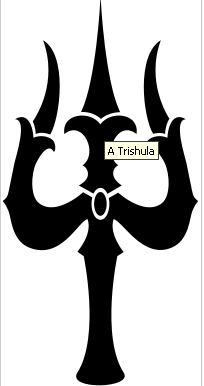 The
symbol can also be found on pictures of Goddess Durga. The Greek god
of the oceans, Poseidon, is also pictured with it.
The
symbol can also be found on pictures of Goddess Durga. The Greek god
of the oceans, Poseidon, is also pictured with it.
Trikona
The triangle, a symbol of Lord Siva.
Veena
It is an Indian stringed instrument similar to European
lyre. Veena is the symbol of art and learning; Goddess Saraswati is
pictured with it.
Vel
This is a symbol of Lord Murugan
(Skanda). Vel is a spear with which Lord Murugan kills evil and
subjugates any knowledge.
Vitthakalai
Vitthakalai is a gold-decorated chariot of Maa Kali
according to the belief of Ayyavazhi (a South Indian religious faith
and sect that originated in South India in about the 19th century).
Yantra
Yantra is a visual representation of a deity most
frequently drawn as geometric shapes (but this is not the rule) -
 it
is the same thing as mantra, but instead of sounds the devotee works
with pictures. There are many Yantras (circle-type, square-type, triangle-type,
etc.) and their lines and shapes can have many meanings. The devotee
may choose a Yantra suited for his/her specific spiritual needs.
it
is the same thing as mantra, but instead of sounds the devotee works
with pictures. There are many Yantras (circle-type, square-type, triangle-type,
etc.) and their lines and shapes can have many meanings. The devotee
may choose a Yantra suited for his/her specific spiritual needs.
Back