Shiva
 Shiva
is the best yogi, tantric and meditator.
For Shaivists, Shiva is the Supreme
Deity.
Shiva
is the best yogi, tantric and meditator.
For Shaivists, Shiva is the Supreme
Deity.
The worship of Shiva
in the pan-Hindu tradition is the oldest one. Shiva's abode
is the Mount Kailash in Tibet.
He has several typical attributes. It is also believed that the Holy
Kaaba (in Mekka), the holiest place for Muslims,
was originally a Shiva lingam
(the black stone). Wherever there is Shiva, there is His emblem
- the crescent moon. The
article here says that Allah in Sanskrit is a synonym for
Mother Divine - Durga.
Carry
Lord Shiva (MaheshaBSD) with you - no matter where you go - OS (operating
system) on a bootable CD with Internet, anonymity, mantras - all is
ready to serve you.
Shaivism has
also its schools, for example, Shaiva Siddhanta
is one of the oldest extensively practiced schools of Sanatana
Dharma. It is built upon the twenty-eight Shaiva
Agamas - special manuals for sacred worship. A famous guru
of this school was Maharishi Nandinatha
(about 250 BCE), who is also on records in the Panini's (Sanskrit
grammarian) book of grammar. Other Shaiva schools are: Pashupata
Shaivism, Siddha Siddhanta, Lingayatism,
Shiva Advaita, and Trika
(Kasmir Shaivism).
Shiva's name in the Vedas is Rudra
and also Sasisekhara [S'as'is'ekhara]
(having moon on his forehead).
Attributes of Lord Shiva
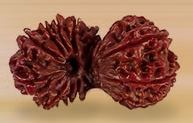 1) Rudraksha beads
These beads, as legends say, had originated from
Lord Shiva's tears from which Rudraksha
trees emerged. Rudraksha beads, the natural products of these
trees, are used to form a sacred saivite rosary with 108 beads.
2) Third Eye:
Shiva is depicted with the third eye.
3) Serpents: Shiva is often shown garlanded
with snakes.
4) Vibhuti: Vibhuti is three lines of ashes drawn horizontally on the forehead (it symbolizes
Shiva's essence, our beingness, impurities of ignorance, and immortality
of the soul).
three lines of ashes drawn horizontally on the forehead (it symbolizes
Shiva's essence, our beingness, impurities of ignorance, and immortality
of the soul).
5) Trident: (Sanskrit: Trishula) Shiva's weapon
is the trident.
6) Ashes: Shiva smears His body with ashes
(bhasma).
7) Sacred Ganga: Ganga, the holiest of the
holy rivers.
8) Drum: A small drum shaped like an hourglass
is known as a "damaru". This is one of the attributes of
Shiva in His famous dancing representation known as Nataraja.
A specific hand gesture (mudra) called damaruhasta is used to hold
the drum. This drum is particularly used as an emblem by members of
the Kapalika sect.
9) Tiger skin: He is often shown seated upon
a tiger skin.
10) A Shiva Linga
11) Nandi, the Bull, is his Vahana
(a Sanskrit term for vehicle).
 12)
The five mantras - Five is a sacred
number for Lord Shiva, but also 64 and 1008. Shiva's body is said
to consist of the five mantras called the pancabrahmans:
12)
The five mantras - Five is a sacred
number for Lord Shiva, but also 64 and 1008. Shiva's body is said
to consist of the five mantras called the pancabrahmans:
1) Sadyojata, 2) Vamadeva,
3) Aghora, 4) Tatpurusa, 5) Isana
13) The Holy Mountain Kailash in Tibet
Picture on the left: Nandi, the Bull, is Shiva's vehicle.
14) Pancha Kedar - the
five places (Pancha Kedar), where devotees worship Lord Shiva
as five holy parts of the Lord Shiva's body.
Shiva is the God of paradoxes.
Ribhu Gita
Ribhu Gita, an apparently very ancient text, is an extract
from a much longer epic - the Sivarahasya Upa Purana. The Ribhu
Gita means the "Ribhu's Song"; it comes from the Shiva
Rahasya (Sivarahasya Upa Purana), which is an ancient mystical
text. The whole of the Ribhu Gita is said to represent the
teaching given to the Sage Ribhu by Lord
Shiva Himself. The book has 44 chapters. Ribhu
Gita is comparable to the traditional Gita (from
Mahabharata) in certain parts and with
verses similar to those spoken by Krishna - for example (in
Chapter 8, verse 28, Lord Shiva says): "Among
Serpents, I am Ananta. Among Military Leaders I am the Supreme Commander
of the Hosts of Heaven."
Manifestations of Lord Shiva
Shiva as the Supreme Lord
has many manifestations too. Bhairava, sometimes also known
as Bhairadya (with many other names), is the fierce form of
Lord Shiva. This form is one of the most important deities
in some parts of Nepal. Bhairava is invoked in prayers to destroy
foes and the name should not be misunderstood with Bhairavi,
which is not Lord Shiva, but His consort
Durga in Her most terrifying aspect almost indistinguishable from
Kali.
There are few stories about the origin of Bhairava.
Few of them cover the tale of Sati, the first
Shiva's wife. Sati, the daughter of an ancient god
- Daksha (in Satya Yuga), had chosen to marry Shiva.
Daksha disapproved this because for him Shiva was rather
a paradoxical ascetic character associated with
animals, ash, snakes, and ghosts. One day, Daksha held
a religious sacrifice (yagna) and invited all the gods, but
not Sati and Shiva. However, Sati came uninvited
to look at the sacrifice rituals and after hearing her father's sharp
and ridiculing words in direction of Shiva she threw herself
into the ritual pyre. (This is also why the
custom "Sati", when
widowed women ended their life alive in the funeral
pyre with their deceased husbands, preserved later in India.)
When Shiva found out what happened,
He destroyed the yagna and killed Daksha.
Shiva then took the Sati's corpse
on His back and ran fiercely all around the world demolishing everything.
Lord Vishnu wanted to help Shiva
and used His divine discus to cut the Sati's body into
pieces in order to stop the Shiva's outrage.
The pieces of Sati's body fell
all around and the spots her parts fell onto are now known as Shakti
Peethas. Shiva is believed to be guarding each of
these Shakti Peethas in His fiercest
form called Bhairava. Parvati
is the incarnation of Sati and She (not Sati) is the Mother
of Ganesha and Skanda
as the Shiva's second consort.
Bhairava has eight forms:
1) Kala Bhairava, 2) Asitanga Bhairava, 3) Samhara Bhairava, 4) Ruru
Bhairava, 5) Krodha Bhairava, 6) Kapala Bhairava, 7) Rudra Bhirava
and 8) Unmatta Bhairava.
Bhairava is the important deity of the Newa indigenous
people of Nepal.
Lord Shiva
has also His month. In Ribhu Gita it is written (Shiva says):
"Among Months, I am Margashirsha
(November-December)."
Ardhanari
In Hinduism, Ardhanari is an androgynous (both male and female)
deity composed of Shiva and His consort Shakti, representing
the synthesis of masculine and feminine energies. Sometimes called
Ardhanarishvara, Shiva in this form is the Lord whose
half is female. Some people interpret both forms as "the half
male" (Shiva) and "the half female" (Parvati).
The origin of the word "Sloven"
is not quite clear. In Tamil, one of the oldest languages in the
world (of Dravidian origin), the word "sol"
(the term may also be inflected as "solu-", "solv-",
etc.) means "to praise", but also "to say",
which is surprisingly consistent with the meaning of our Slovak words
such as "to celebrate" (slavit)
or "to praise". Slovak "slovo" in
English is "word". Some ideas presented by Dr.
Cyril A. Hromnik, for example, support the hypothesis that the
root of the name "Sloven", "Sloveni", "Slovak"
(or "Slavian", etc.) comes from two Tamil words -
"sol" and "veni".
Dr. Hromník supports this viewpoint by few other Tamil words almost
identical with Slovak - for example, "tassar" (Tamil),
which means the same as Slovak "carpenter" ("tesar"
in Slovak; however, there are many other similar words). The second
word "veni" in Tamil
means dense and entangled hair. The term "Sloveni"
may therefore refer to the people who praised someone with big
hair. The only God we know of that has big hair is Lord
Shiva. The links between the ancient Slavic people and
Dravidians must have been very intimate.

Back