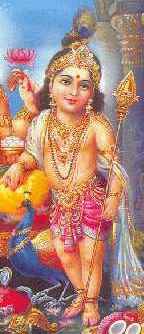
Skanda
In Chinese
Buddhism, Skanda Bodhisattva or Wei Tuo is a devoted celestial
protector of temples who protects Dharma...
 Very
interesting is the fact that some ancient manuscripts, or preserved
oral heritage of various tribes contain information about the "mythical
twins" in reference to the beginning of the world - the Creation of
life. Allegedly, also the Hopi Tribe has a prophecy about the Twin
Warriors... In the culture of the Toltecs, Quetzalcoatl was
considered the God of the morning star and his twin brother, Xolotl,
the God of the evening star...
Very
interesting is the fact that some ancient manuscripts, or preserved
oral heritage of various tribes contain information about the "mythical
twins" in reference to the beginning of the world - the Creation of
life. Allegedly, also the Hopi Tribe has a prophecy about the Twin
Warriors... In the culture of the Toltecs, Quetzalcoatl was
considered the God of the morning star and his twin brother, Xolotl,
the God of the evening star...
The word "twin" is used here because
Lord Skanda is sometimes perceived as twin God - Skanda-Murukan. The
introductory part of Vamsa Brahmana (one of commentaries on the Samaveda),
for example, enumerates the list of deities (to whom water libations
are to be offered) and among these deities is the Skanda-Visakhau
twin figure.
Skanda
(but also Subrahmanya, Kumara, Arumugan, Shanmugan,
Murugan, Guha...) belongs
to the Shaiva system. Ramayana has chapters on His birth. Some
Indian epics and puranas seem to indicate that He was the eldest son
of Shiva. But because of the fact that Lord Murugan (He is
mostly "God of the South" - Tamil Nadu, Sri Lanka, Singapore,
Australia, Mauritius, South Africa) has not so many devotees as Lord
Ganesh (in India), the prevailing opinion in India is that Lord Ganesh
is older than Lord Murugan. Both views have their support in ancient
Indian texts.
Skanda, the second
son of Shiva and the younger
brother of Ganesha - but some scholars oppose this view and
consider Skanda to be older than Ganesha, is also known as Kumara,
Karttikeya, Shanmukha, Subrahmanya, and He has many other names.
His weapon is spear and He is considered to be a war God. He has a
strong support in South Asia (South of India - Indian state Tamil
Nadu, Sri Lanka, Singapore...).
Followers of this God consider Him to be the Avatar
of Lord Shiva. They also think that Lord Skanda and
Lord Krishna are one, and as evidence they use this verse from
Bhagavadgita (Chapter 10), where Lord Krishna says this
to Arjuna: "Senaninam Aharn Skandah,"
- "Of the Generals, I am Skanda."
A good article about Skanda can be found on the Murugan.org
website: http://murugan.org/research/child_god.htm
Sadkona Yantra
Yantra is a symbolic visualization of a deity;
yantras often look like a matrix with geometrical lines and when we
visualize it in our mind, we clear the path on our way to God (mantra
is a sound, usually a holy word, a syllable, or a sequence of such
words we repeatedly pronounce, most frequently in Sanskrit).
 Skanda emerged from the light of the six Shiva's
sparks, which flashed from the Lord Shiva's Third Eye. Skanda
Yantra is almost identical with the famous hexagram - the Jewish
Star, or the Star of David. The Seal of Solomon
also contained the hexagram image - the "yantra" of the Biblical
God YHVH - Yahve (the word "yantra" is not used in Jewish-Christian
religions, though).
Skanda emerged from the light of the six Shiva's
sparks, which flashed from the Lord Shiva's Third Eye. Skanda
Yantra is almost identical with the famous hexagram - the Jewish
Star, or the Star of David. The Seal of Solomon
also contained the hexagram image - the "yantra" of the Biblical
God YHVH - Yahve (the word "yantra" is not used in Jewish-Christian
religions, though).
The Atharva Veda
describes Kumaran as "Agnibhuh",
or son of Agni, the fire god. The Satapatha
Brahmana refers to Him as the son of Rudra
and the ninth form of Agni.
The Seal of Solomon was a magical signet ring
said to have been possessed by King Solomon, which gave him
the power to command demons, or to do other miraculous things. The
God's name - Tetragrammaton ("word with four letters" - YHVH)
- was written on it. The identical depiction of the God Skanda's symbol
and of the Jewish one - Sadkona Yantra
/ Star of David - gives a strong tinge
to any argumentation in favor of the fact that humankind has one common
history and that the same God spoke to Jews and to other people on
this Earth in ancient times.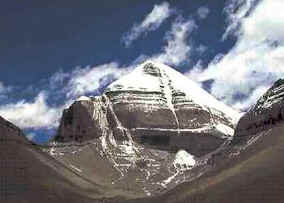
The pillar
of Shaivism, Buddhism, and other
denominations, too, is Mt. Kailasa - a 6638 meter high mountain in
the Himalayas (Tibet). It is also called the "Svastika
Mountain".
Back